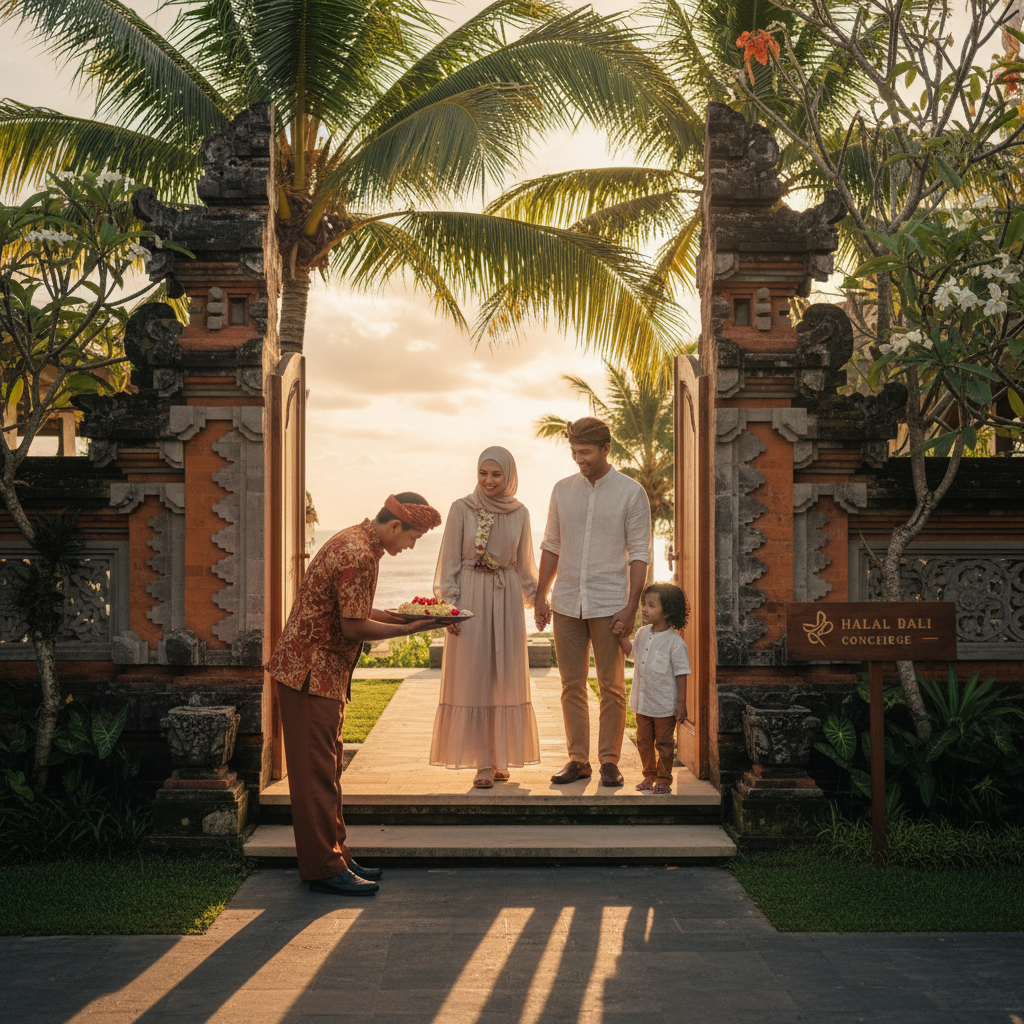
Halal Bali Tourism FAQ for Muslim Travellers
What Is Halal Bali Tourism?
Halal Bali tourism is a travel category specifically designed for Muslim travellers visiting Bali, combining alcohol-free villa or resort accommodation, daily meals exclusively from halal-certified restaurants or Muslim private chefs, structured prayer-time stops aligned with the local adhan schedule, female-only spa options, family activities respecting modesty and Islamic etiquette, and Hindu temple visits handled with observational respect rather than ritual participation. This FAQ answers 16 of the most common questions Muslim travellers ask before booking a Bali holiday.
- Q1: Is Bali safe for Muslim tourists?
- Yes. Bali is safe for Muslim tourists in every practical sense. Crime rates are very low, religious tolerance is genuine with Muslims commonly seen in hijab and traditional dress throughout Bali, halal food is widely available across Seminyak, Ubud, Nusa Dua, Jimbaran, Sanur, and Canggu, mosques are accessible in every region with the largest being Masjid Agung Ibnu Batutah in Denpasar, and Hindu locals are uniformly respectful of Muslim visitors. The cultural-density of Bali’s Hindu heritage initially feels unfamiliar to some travellers but does not constitute a safety concern.
- Q2: Is halal food easy to find in Bali?
- Yes. Bali has more than 50 verified halal restaurants across the main tourist regions, ranging from authentic Indonesian Padang and Sundanese kitchens to halal Japanese sushi, halal Korean BBQ, halal Italian pizza, halal Indian biryani, and halal Mediterranean. The gold standard is MUI Indonesia halal certification displayed at the restaurant entrance with a verifiable certificate number. Muslim-owned warungs without formal certification but with verifiable supply chains are also widely trusted. For maximum confidence, our concierge service arranges Muslim private chef in your villa for some or all meals.
- Q3: Are there mosques in Bali?
- Yes. Major mosques include Masjid Agung Ibnu Batutah (Denpasar, the largest), Masjid Al-Muhajirin (Kuta, walking distance from most Seminyak resorts), Masjid Al-Ittihad (central Ubud), and a masjid inside Ngurah Rai International Airport accessible to all travellers including those in transit. Most major shopping malls including Beachwalk Seminyak, Discovery Mall Kuta, and Mall Bali Galeria have prayer rooms (musalla) with separate male and female sections, sajadah provided, and wudhu facilities.
- Q4: Can I find an alcohol-free villa in Bali?
- Yes. Our concierge network includes more than 30 alcohol-free villas across Seminyak, Ubud, Nusa Dua, Jimbaran, Uluwatu, Canggu, and Sanur. Every villa we book carries a written alcohol-free guarantee covering the full duration of your stay, with the minibar emptied and removed before arrival, no alcohol service from villa staff regardless of guest request, and pre-arrival inspection by our concierge team to confirm compliance. The same applies to resort rooms in Nusa Dua and other multi-room properties.
- Q5: Are prayer mats and qibla direction provided in Muslim-friendly villas?
- Yes. Every villa in our network has sajadah and prayer mats placed in at least the master bedroom with qibla direction marked clearly using a small wall arrow or marked sticker pointing toward Mecca. Premium villas include a dedicated musalla room with full prayer set. We also provide a printed adhan schedule for the exact dates of your stay covering subuh, dzuhur, ashar, maghrib, and isya in WITA timezone, plus a digital qibla compass for confirmation.
- Q6: Can I visit Hindu temples in Bali as a Muslim?
- Yes, with respectful observation. Visiting Hindu temples for architectural and cultural appreciation is permissible from observation distance. Do not enter inner shrine areas, do not touch offerings (canang sari), do not participate in ceremonies, do not photograph during ceremonies unless invited, and do not perform any ritual action including head-bobbing or folding hands. Observation as a tourist is no different from visiting a Christian cathedral or Buddhist heritage site. Our guides brief families before each visit and accompany throughout to ensure proper etiquette.
- Q7: Are there female-only spa options in Bali?
- Yes. We work with three women-only spa establishments in Seminyak and Ubud where Muslim women in hijab can receive full-body traditional Balinese massage, hammam-style scrub, and creambath hair therapy from female therapists exclusively in private rooms with no male staff entering. Additionally, in-villa spa with our network of certified female Balinese therapists is widely available and provides maximum privacy for women preferring to receive treatment in their own accommodation.
- Q8: Can women wear burkini at Bali beaches and pools?
- Yes. Modest swimwear including burkini is fully comfortable at all major Bali beaches, with Sanur and Nusa Dua being the most family-friendly options for women in burkini due to calmer waters and family-oriented clientele. All resort and villa pools are private or semi-private. Theme parks such as Waterbom Bali explicitly welcome modest swimwear and burkini. Beachfront cabana service with screening can be arranged for additional privacy when requested.
- Q9: How are prayer times scheduled during a Bali tour?
- Our standard schedule integrates the five daily prayers as follows. Subuh is completed at your accommodation upon waking, around 05:00 WITA. Dzuhur is scheduled at a partner masjid in whichever region the day’s activities are based, around 12:30 WITA. Ashar is at a masjid, attraction prayer room, or accommodation depending on timing, around 15:30 WITA. Maghrib is timed to coincide with return to accommodation, around 18:30 WITA. Isya is at the accommodation, around 19:30 WITA. Drivers carry the printed adhan schedule and pause activities five minutes before each prayer time.
- Q10: What is the best time of year for Muslim travellers to visit Bali?
- The dry season from May to October offers the most consistent weather for outdoor activities, with average temperatures of 26 to 30 degrees Celsius and minimal rainfall. The peak tourist season is July and August (school holidays in many countries) and December (international winter break). For Muslim travellers specifically, we recommend avoiding the Nyepi period in March (the Balinese Day of Silence requires staying inside accommodation for 24 hours) and major Hindu ceremony periods such as Galungan and Kuningan. Ramadan can be a meaningful time to visit with halal-friendly suhoor and iftar arrangements available, but daytime activity intensity should be reduced.
- Q11: Can I travel to Bali with elderly parents who require accessibility?
- Yes. Our concierge service specialises in multigenerational family bookings including elderly grandparents requiring mobility considerations. We adjust itineraries to remove long walking sequences, select villas with single-level layouts and ground-floor master bedrooms, arrange wheelchair-accessible vehicles where needed, schedule shorter activity days with longer rest periods, and book restaurants with easy-access seating. Halal compliance and prayer logistics remain identical to our standard packages.
- Q12: How much does a halal Bali holiday cost?
- Pricing depends on package length, accommodation tier, group size, and meal arrangements. Our 5-day Ubud-Seminyak Discovery package starts from approximately USD 850 per person twin-sharing in standard category, our 7-day Family Halal Bali Adventure starts from approximately USD 1,250 per person twin-sharing, and our 10-day South Bali Comprehensive starts from approximately USD 2,200 per person twin-sharing. All prices include accommodation, all halal meals, all transport, all activities, all entry tickets, all prayer logistics, and 24-hour concierge support. Group bookings of 8 or more receive automatic 10 percent reduction.
- Q13: How do I book a halal Bali tourism package?
- Send your travel dates, party composition (number of adults, children with ages, any elderly with mobility needs), preferred package option, and any specific Islamic-practice considerations beyond standard halal to bd@juaraholding.com or WhatsApp +62 811 3941 4563. We respond within 4 working hours with a draft itinerary and transparent quote. A 30 percent deposit confirms your booking. The balance is due 14 days before arrival. Cancellation more than 30 days from arrival receives a full refund. Cancellation between 14 and 30 days receives a 50 percent refund. Cancellation within 14 days is non-refundable.
- Q14: Is Ramadan fasting (puasa) compatible with a Bali holiday?
- Yes. Many Muslim travellers visit Bali during Ramadan with our concierge support adapted accordingly. We arrange halal suhoor (pre-dawn meal) at your accommodation, schedule lighter daytime activities to conserve energy during fasting, plan iftar (breaking fast) at halal restaurants near your accommodation timed precisely with maghrib, include taraweeh prayer at the nearest masjid for those who wish to attend congregation, and adjust transport timing to avoid energy-intensive long drives. Bali’s local Muslim community is welcoming and our team includes Muslims who personally fast during Ramadan, ensuring genuine understanding of the schedule.
- Q15: Are there halal-friendly five-star resorts in Bali?
- Yes. Several five-star resorts in Bali operate dedicated halal kitchens, alcohol-free room options, on-site masjid, and female-only spa wings. The Mulia Nusa Dua, several Marriott properties, and selected resorts in Jimbaran and Uluwatu offer halal-certified restaurants on premises with formal MUI certification. For families preferring full villa privacy, our 6-bedroom luxury cliff villas in Uluwatu and Jimbaran with Muslim private chef service deliver an arguably more intimate five-star experience than any resort.
- Q16: Can my children eat halal at Bali theme parks and attractions?
- Yes. Major Bali theme parks and family attractions offer halal food on-site or are walking distance from halal alternatives. Waterbom Bali has a halal food court with chicken katsu, nasi goreng, and satay (plus a dedicated prayer room). Bali Safari and Marine Park has Tsavo Lion Restaurant with MUI halal certification. Bali Bird Park has halal options at the on-site cafe. The Mason Adventures elephant park and rafting facility provides halal lunch on request. For Devdan Show in Nusa Dua, halal pre-show dinner is available at the resort restaurant.
Still Have Questions About Halal Bali Tourism?
If your specific question is not covered here, our team is happy to discuss your unique requirements directly. Common additional questions involve specific dietary restrictions beyond halal (such as gluten-free or seafood allergies), accessibility for travellers with disabilities, group bookings for 12 or more travellers, corporate retreat planning for Muslim professionals, and honeymoon-specific arrangements. For full package details, browse our halal Bali tourism packages guide. For restaurant specifics, see our verified halal restaurants directory. For accommodation options, check our Muslim-friendly Bali villas guide. For a real example of how a week unfolds, read our complete 7-day family itinerary.
Halal Bali Tourism Concierge
Email: bd@juaraholding.com
WhatsApp: +62 811 3941 4563
Operating across Seminyak, Ubud, Nusa Dua, Jimbaran, Sanur, Canggu, Uluwatu, and North Bali
People also ask about this
- Is it easy to find halal food in Bali?
- Finding halal food in Bali is increasingly straightforward, with over 100 MUI-certified restaurants and countless Muslim-owned warungs. Tourist-heavy areas like Kuta, Seminyak, and Denpasar offer the most options, ranging from local Indonesian dishes to international cuisine. For assurance, always look for the official green MUI halal logo.
- What is the best area in Bali for halal food?
- The best areas for halal food in Bali are Kuta, Seminyak, and the capital, Denpasar. These locations have the highest concentration of certified restaurants and Muslim-friendly eateries. While areas like Ubud and Nusa Dua have options, Kuta and Seminyak provide the greatest variety for Muslim travelers seeking guaranteed halal meals.
- How can I verify a restaurant is halal in Bali?
- To verify a restaurant’s halal status in Bali, look for the official certificate from the Majelis Ulama Indonesia (MUI). This green logo is typically displayed at the entrance or cashier. You can also ask staff directly about their halal certification or check online directories that specifically list MUI-approved establishments.
- How much does a halal meal cost in Bali?
- The cost of a halal meal in Bali varies by location and style. A meal at a local eatery (warung) typically costs between IDR 30,000 to IDR 60,000. In a mid-range halal restaurant in Seminyak or Kuta, expect to pay from IDR 80,000 to IDR 170,000 per main course.
- What local Balinese food is halal?
- Many famous Balinese dishes are halal if prepared without pork. Key examples include Ayam Betutu (spiced chicken), Sate Lilit Ayam (minced chicken satay), and Nasi Campur Bali from a Muslim vendor. Always confirm with the seller that no pork products (‘babi’) were used in the cooking process.
- Are there halal villas in Bali?
- Yes, Bali offers a growing number of Muslim-friendly or halal villas, particularly in Seminyak, Canggu, and Ubud. These properties provide amenities such as halal-certified food service, private pools that are not overlooked, prayer mats, and Qibla direction indicators to cater specifically to the needs of Muslim travelers.
- Does Seminyak have good halal food options?
- Seminyak is one of the best areas for halal food in Bali, offering numerous choices from local warungs to upscale restaurants. You can find authentic Indonesian, Middle Eastern, and Western cuisine that is MUI-certified. Many options are located along Jalan Raya Seminyak and the surrounding side streets.
- What is an MUI Halal Certificate?
- The MUI Halal Certificate is the official religious endorsement in Indonesia, issued by the Majelis Ulama Indonesia. This certification guarantees that a restaurant’s ingredients, food preparation process, and supply chain strictly adhere to Islamic law. It is the most reliable indicator of a truly halal establishment in Bali.
- Why is finding halal food in Bali a concern for tourists?
- The main concern is that Bali is a Hindu-majority island where pork (‘babi’) is a popular ingredient in many traditional dishes, like Babi Guling. Unlike other parts of Muslim-majority Indonesia, travelers here must be more vigilant to avoid cross-contamination and find restaurants that are officially certified halal by MUI.
- Can you find mosques in Bali’s tourist areas?
- Yes, mosques are accessible in most of Bali’s main tourist hubs. Major areas like Kuta, Denpasar, Sanur, and Nusa Dua have several mosques for daily and Friday prayers. While less common in Ubud, prayer facilities (‘musholla’) can still be found in certain locations or larger hotels.
- Do Bali hotels serve halal breakfast?
- Many large 4 and 5-star hotels in Bali offer halal-friendly breakfast options. They typically separate pork dishes and use dedicated utensils, although the entire kitchen may not be certified. For a fully guaranteed halal breakfast, it is best to stay at a designated Muslim-friendly hotel or confirm with management beforehand.