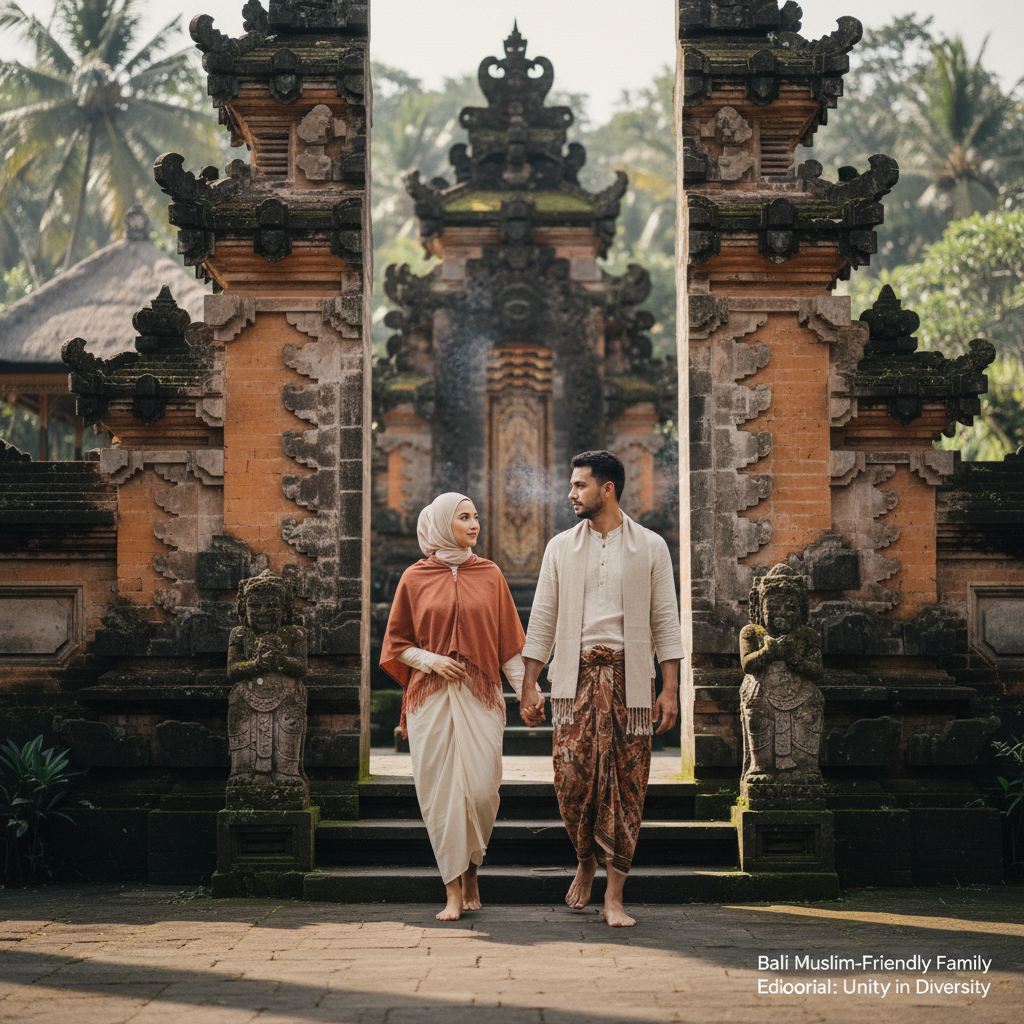
Is Ubud Safe for Muslim Tourists? Honest Assessment for Muslim Travellers
Is Ubud Safe for Muslim Tourists?
Ubud is safe for Muslim tourists in every meaningful sense: physical safety is excellent with very low crime rates, religious tolerance is genuine with Muslim travellers commonly seen in hijab walking comfortably through town, halal food is widely available with several Muslim-owned warung restaurants, the Masjid Al-Ittihad serves the Muslim community right in central Ubud, and Hindu locals are uniformly respectful of Muslim visitors. The honest concerns Muslim travellers have about Ubud are not safety concerns but cultural-density concerns: Ubud is the heart of Balinese Hindu culture, temples are visible everywhere, ceremonies happen frequently in public spaces, and offerings (canang sari) are placed on shop floors and sidewalks. None of this poses any risk to Muslim travellers, but it can feel unfamiliar at first. This honest assessment walks through the real considerations.
What Muslim Tourists Actually Worry About in Ubud
Based on direct conversations with hundreds of Muslim families we have hosted in Ubud, the most common concerns are: whether halal food is sufficient (yes, more than 12 verified restaurants), whether mosques are accessible (yes, Masjid Al-Ittihad is in central Ubud), whether prayer can be done quietly without being disturbed (yes, all our partner villas have dedicated prayer corners), whether Hindu temples will somehow conflict with Islamic practice (no, observation does not constitute participation), whether children will be confused by Hindu imagery (handled with simple parental explanation), and whether women in hijab will face any judgement (no, Ubud is one of the most internationally diverse towns in Bali). We address each below.
Halal Food Availability in Ubud
Ubud has more halal options than most Muslim travellers expect. Our verified halal restaurant list in Ubud includes Warung Bu Mangku (Sundanese, Level 2 Muslim-owned), Mama’s Warung (Indonesian and Western, Level 2), Ibu Oka Rumah Makan Padang Ubud (Padang, Level 1 MUI), Warung Mendez (Mediterranean, Level 2), Bumi Bali Ubud (Balinese without pork or alcohol, Level 1 MUI), Halal Pizza Ubud (Level 2 Muslim-owned), Naughty Nuri’s Halal Branch (Level 1 MUI), Warung Pulau Kelapa (Level 2), and several more. Beyond restaurants, all major Indonesian supermarkets in Ubud (Coco Market, Bintang Supermarket) carry halal-certified products. Self-catering with private chef in your villa is also a strong option for total halal control.
Masjid Al-Ittihad Ubud and Prayer Logistics
The Masjid Al-Ittihad is located in central Ubud on Jalan Sukma, walking distance from most Ubud town accommodations and 5 to 10 minutes drive from villa areas including Penestanan, Sayan, and Tegalalang. The masjid serves approximately 200 to 400 worshippers for jumah prayers and is well-maintained with separate male and female prayer halls, wudhu facilities, and a modest community presence. Daily prayers are held at the standard adhan times. For travellers staying further from Ubud town, prayer at the villa with sajadah and qibla pre-marked is equally valid and our concierge service ensures every villa has these amenities ready. Friday jumah is the most crowded day, with many local Muslim residents attending, and visitors are warmly welcomed.
Hindu Temple Etiquette for Muslim Visitors
This is the most-asked question. Bali’s Hindu temples are extraordinarily beautiful from architectural and craftsmanship perspectives, and many Muslim travellers want to see them without compromising their faith. Our protocol, agreed across hundreds of family bookings, is straightforward: visit from observation distance, do not enter the inner shrine (jeroan), do not touch any offerings (canang sari), do not participate in any ceremony, do not photograph during a ceremony unless the family explicitly invites you, and respond respectfully if greeted by Hindu worshippers. Observing Balinese craftsmanship and architecture is no different from visiting a Buddhist heritage site or a Christian cathedral as a tourist. Many leading Islamic scholars have addressed this question and the consensus is clear: respectful observation is permissible, while participation in non-Islamic worship is not.
Specific Temples in Ubud and How to Visit Respectfully
The most-visited temples near Ubud include Pura Tirta Empul (the holy spring temple, observation only, do not bathe in the springs), Pura Gunung Kawi (rock-cut shrine, observation only, no entry into inner courtyard), Pura Saraswati (Saraswati water temple in Ubud town, observation from outside is sufficient and beautifully photographable), and Pura Goa Gajah (Elephant Cave temple, observation only). Our guides time visits to avoid major Hindu ceremonies (which would be inappropriate for Muslim observers), brief the family before each visit on the temple’s significance, and accompany the family throughout to ensure no inadvertent etiquette breaches. For families uncomfortable with any temple visits, we offer entirely alternative cultural programming: coffee plantation tours, Muslim-owned silver workshops in Celuk village, Ubud rice terrace photography, or traditional Balinese cooking classes (halal versions).
Canang Sari Offerings on Streets and Shop Floors
Walking through Ubud you will see small woven palm leaf trays containing flowers, rice, and incense placed on shop entrances, sidewalks, and motorbike dashboards. These are canang sari, daily Hindu offerings made by Balinese families to maintain harmony between gods, humans, and spirits. They are placed multiple times daily and frequently stepped over inadvertently by tourists. Stepping on canang sari is not an Islamic concern (no ritual significance attaches to you as a Muslim observer), but it is a courtesy concern (the offering has been carefully placed by a Hindu family). Walking around them when easily possible is the polite approach. If you accidentally step on one, no apology or action is required.
Hindu Ceremonies in Public Spaces
Balinese Hindu ceremonies occur frequently and often spill into public streets, with traffic occasionally stopped for processions. As a Muslim observer, the appropriate response is to wait quietly and respectfully, not to photograph the ceremony unless invited, and not to participate in any way (no head-bobbing, no folding hands, no holy water). Our drivers know all the major ceremony schedules and route around them when possible. For larger ceremonies such as Galungan and Kuningan, we adjust itineraries entirely to avoid conflict zones. Nyepi, the Balinese day of silence, is a unique consideration: the entire island including airport and roads is closed for 24 hours, and Muslim travellers visiting during Nyepi must remain inside their accommodation, but pre-Nyepi cultural events the day before are observable from a distance.
Hijab and Modest Dress in Ubud
Ubud is exceptionally accustomed to women in hijab. Of the millions of tourists visiting Ubud annually, a substantial portion are Muslim women from Malaysia, Singapore, Indonesia, and the Middle East, and hijab is a daily sight. No Muslim woman in our 7-year history of Ubud bookings has reported any negative experience related to hijab. Modest dress including long sleeves, long pants or maxi skirts, and headscarf is fully comfortable and beautifully photographable against Ubud’s green landscapes. For temple visits where local etiquette suggests a sash or sarong over modest dress, our guides provide these. For waterfall visits, modest swimwear including burkini is fully accepted at all family-friendly waterfalls including Tegenungan and Tibumana.
Children and Hindu Imagery
Muslim parents sometimes wonder how to handle Hindu statues and imagery for younger children. Our recommendation, refined over many family conversations: explain simply that this is how Hindu families practice their religion, just as we have our own practice as Muslims. Children often handle this conversation more naturally than parents expect. The Sacred Monkey Forest, for example, includes a Hindu temple and statues, but most children are simply focused on the monkeys and trees, and the spiritual context is easily contextualised. We never recommend hiding the cultural reality of Bali from children; instead, frame it as part of understanding Indonesian diversity, and reaffirm Islamic identity through the family’s prayer routine and halal eating practice.
Alcohol and Public Drinking in Ubud
Ubud has cafes and restaurants that serve alcohol, particularly along Jalan Hanoman and Jalan Raya Ubud, but this is concentrated in tourist-heavy areas and easily avoidable. Our halal restaurant recommendations are all alcohol-free or have separate alcohol-free dining areas. Walking through Ubud streets you may occasionally see tourists with beer, but this is no more frequent than in most international tourist towns globally. Your accommodation, with our concierge guarantee, is alcohol-free for the entire stay. Public drunkenness is rare in Ubud compared to Kuta, making Ubud actually a more comfortable choice for families than Bali’s main beach party towns.
Female Spa and Wellness Options
Ubud is internationally famous for spa and wellness, and we have identified three female-only spa establishments where Muslim women in hijab can receive full-body traditional Balinese massage, hammam-style treatment, and creambath hair therapy from female therapists exclusively in private rooms with no male staff entering. For maximum privacy, in-villa spa is also widely available with our partner female therapists travelling to your accommodation. Yoga classes in Ubud, while popular, often include spiritual elements that may not align with Islamic practice; we recommend selecting purely physical yoga (hatha, restorative) over spiritually-oriented classes (kundalini, tantra) and confirming with the instructor that no chanting is required.
Practical Logistics for Ubud Stays
Our recommended Ubud arrangements for Muslim families include staying in Penestanan or Sayan (rice-field villa areas with privacy), having a Muslim driver-guide on standby (so you control your own pace including prayer breaks), eating mostly at the verified halal restaurants on our list, doing temple visits with a guide who briefs the family before each entry, scheduling waterfall and rice terrace visits in early morning or late afternoon to avoid crowds, and combining Ubud with 2 to 3 nights in Nusa Dua or Seminyak for beach time afterward. A 7-day itinerary covering Ubud-plus-beach is our most-booked format.
Bottom Line: Ubud Is Comfortable, Different, Beautiful
Ubud is not a town to fear as a Muslim traveller. It is a town to approach with curiosity and respectful boundaries. The cultural density that initially feels unfamiliar becomes one of the most enriching aspects of the holiday, especially for children gaining their first exposure to Indonesian Hindu heritage. With the right concierge support, halal food is plentiful, prayer is uninterrupted, modesty is fully comfortable, and the experience is one of the most spiritually grounding holidays possible. Read our full halal Bali tourism package guide with Ubud included, browse the verified halal restaurants list covering Ubud establishments, or see exactly how a 7-day family itinerary integrates Ubud with beach time.
Halal Bali Tourism Concierge
Email: bd@juaraholding.com
WhatsApp: +62 811 3941 4563